

Frequently Asked Questions
PeCOD® COD/BOD Analyzer
General Information
Why are my PeCOD values reading low in comparison to the dichromate method?
The most common cause is chloride interference.
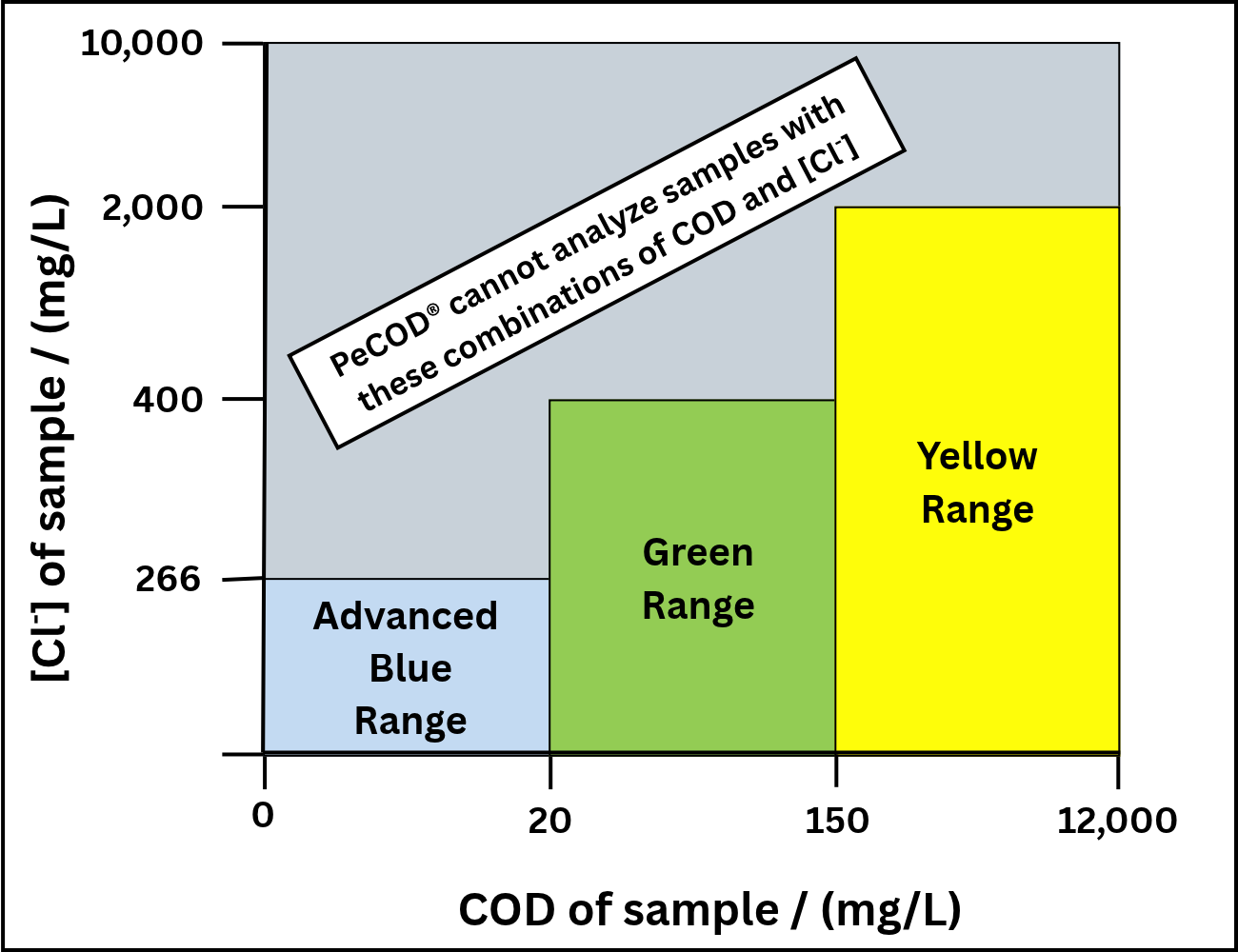
Chloride interference can impact COD outputs no matter what methodology is used. For the PeCOD method, the interference is negative – the samples are measured as having lower COD values than expected (see the figure below for recommended limits). Meanwhile for the dichromate method, the interference is positive and results in higher COD values. This results in a significant discrepancy between the two different methods with neither measurement accurate when a chloride interference exists!
The solution for this challenge is as simple as diluting the problematic samples until the chloride concentration falls below the maximum allowance. The lowest range on the PeCOD has a maximum allowance of 400 mg/L while the dichromate method’s is 100 mg/L according to Standard Method 5220. This can be increased to 1500 mg/L with supplementary mercury sulphate. Additionally, the detection limit of COD in the PeCOD is 0.7 mg/L in Advanced Blue and 1.0 mg/L in Green range. It is 50 mg/L for the dichromate method when looking for quantitative results or 1.0 mg/L when estimated. This makes the PeCOD more suitable for both low-COD high-chloride samples as well as samples that need significant dilution due to high chloride levels.
In addition to the PeCOD method having higher chloride tolerance with lower detection limits, COD (and BOD) results are generated in 10 minutes utilizing a safe and green method.
What pH range can the peCOD method measure in?
The peCOD method requires that the pH of a sample AFTER being mixed with electrolyte must be between 4 – 10. To determine if a sample must be pH-adjusted, mix the sample with PeCOD® electrolyte at the proper mixing ratio for your COD range, then test the pH of the mixture. For example, the sample may have a pH of 3.0, but then after preparing with electrolyte, the pH is in the required range, therefore, it is acceptable for immediate PeCOD® measurement. If samples have been preserved in acid, they should be neutralized using sodium hydroxide prior to analysis to avoid a low reading, as well as damage to the sensor. When the sample pH is below 4, the photocatalytic oxidation at the TiO2 sensor is affected, leading to poor reproducibility and charge values below theoretical expectation. Below a pH of 2, the TiO2 displays instability. When the pH is above 10, the charge measured for the reference and sample solution yield lower than expected values, again caused by interference at the TiO2 sensor. Sulphuric acid should be used to lower the pH of samples with a pH of 10 or more.
Get Smarter Solutions, Today.
Our innovative water and wastewater analyzers have faster, safer processes, with fewer hazardous reagents. Start using MANTECH solutions for more accurate data that drives responsible outcomes.