

Frequently Asked Questions
PeCOD® COD/BOD Analyzer
COD Application
Why is COD higher than BOD?
COD is normally higher than BOD because more organic compounds can be chemically oxidized than biologically oxidized. This includes chemicals toxic to biological life, which can make COD tests very useful when testing industrial sewage as they will not be captured by BOD testing.
What is the COD BOD ratio in domestic sewage influent?
BMS have recorded average ratios of 2-3 mg/l COD to 1 mg/l BOD over its 30 years of business. Influent COD in normal domestic sewage is therefore generally 600 – 900 mg/l and it is then treated to at least 30 -100 mg/l before discharge to minimize pollution potential.
How should COD samples be stored?
MANTECH recommends storing samples in the laboratory fridge vs preserving samples. If you do choose to preserve your samples, use H2SO4 to adjust the pH of your samples to ~2.
What is the difference between chemical oxygen demand and biochemical oxygen demand?
Chemical Oxygen Demand (COD) analysis is a measurement of the oxygen-depletion capacity of a water sample contaminated with organic waste matter. Specifically, it measures the equivalent amount of oxygen required to chemically oxidize organic compounds in water. The traditional COD method is the wet chemistry method, dichromate COD (CODCr). This involves a two hour digestion at high heat under acidic conditions and involves hazardous chemicals such as mercury and dichromate. Biochemical Oxygen Demand (BOD), also often referred to as biological oxygen demand, is a test performed to measure the potential of wastewater and other waters to deplete the oxygen level of receiving waters. The BOD test involves taking an initial dissolved oxygen (DO) reading and a second reading after five days of incubation at 20°C. For this reason, this test is often written as BOD5 for short. MANTECH has developed an automated COD method utilizing a new, rapid and green technology called the PeCOD® COD Analyzer. This method directly measures the amount of oxidizable material in a sample via photoelectrochemical oxidation in a microcell, eliminating the need for time-consuming digestion and hazardous chemicals as only an electrolyte solution is required for analysis.
What is chemical oxygen demand (COD)?
Chemical Oxygen Demand (COD) analysis is a measurement of the oxygen-depletion capacity of a water sample contaminated with organic waste matter. Specifically, it measures the equivalent amount of oxygen required to chemically oxidize organic compounds in water. COD is used as a general indicator of water quality and is an integral part of all water quality management programs. Additionally, COD is often used to estimate BOD (Biochemical Oxygen Demand) as a strong correlation exists between COD and BOD, however COD is a much faster, more accurate test. Learn more here.
What happens if COD is high?
Higher COD levels mean a greater amount of oxidizable organic material in the sample, which will reduce dissolved oxygen (DO) levels. A reduction in DO can lead to anaerobic conditions, which is deleterious to higher aquatic life forms.
What causes high COD in wastewater?
COD increases as the concentration of organic material increases. It also increases if inorganic compounds susceptible to oxidation by the oxidant (typically dichromate) are present. Water with high COD typically contains high levels of decaying plant matter, human waste, or industrial effluent.
General Information
How does the PeCOD® Analyzer calculate COD?
The PeCOD® analyzer performs advanced oxidation on a small volume of sample. As the reaction proceeds, electrical charge is generated proportional to the oxygen being consumed. The PeCOD® analyzer captures this generated charge, plotting the output current from the reaction over time as shown below. The area under the curve generated by plotting current over time is proportional to the oxygen demand of the sample. A blank charge is also determined for each sample, and subtracted from the total charge to ensure accuracy.
View the detailed overview of peCOD technology and calculations here.

Why are my PeCOD values reading low in comparison to the dichromate method?
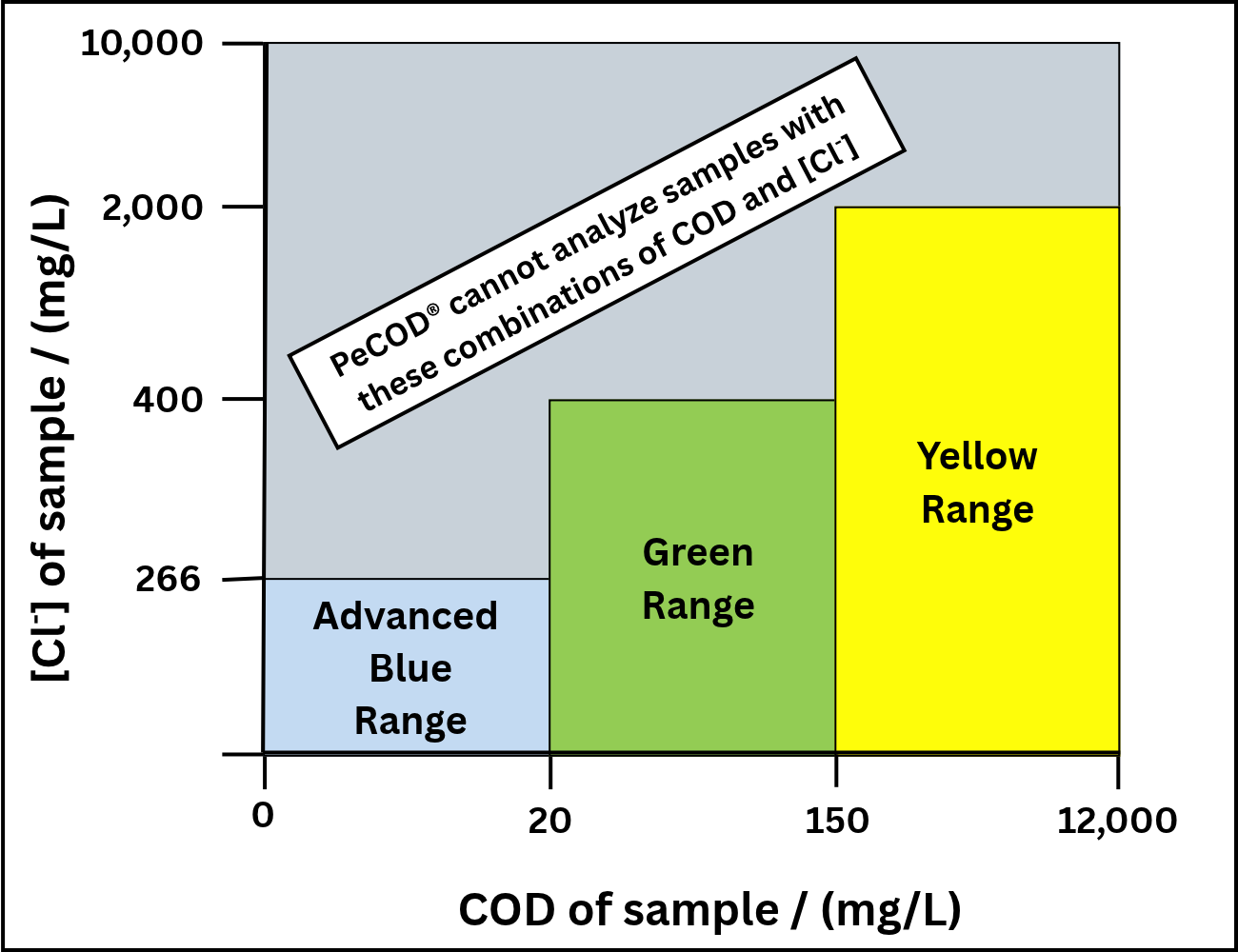
The most common cause is chloride interference.
Chloride interference can impact COD outputs no matter what methodology is used. For the PeCOD method, the interference is negative – the samples are measured as having lower COD values than expected (see the figure below for recommended limits). Meanwhile for the dichromate method, the interference is positive and results in higher COD values. This results in a significant discrepancy between the two different methods with neither measurement accurate when a chloride interference exists!
The solution for this challenge is as simple as diluting the problematic samples until the chloride concentration falls below the maximum allowance. The lowest range on the PeCOD has a maximum allowance of 400 mg/L while the dichromate method’s is 100 mg/L according to Standard Method 5220. This can be increased to 1500 mg/L with supplementary mercury sulphate. Additionally, the detection limit of COD in the PeCOD is 0.7 mg/L in Advanced Blue and 1.0 mg/L in Green range. It is 50 mg/L for the dichromate method when looking for quantitative results or 1.0 mg/L when estimated. This makes the PeCOD more suitable for both low-COD high-chloride samples as well as samples that need significant dilution due to high chloride levels.
In addition to the PeCOD method having higher chloride tolerance with lower detection limits, COD (and BOD) results are generated in 10 minutes utilizing a safe and green method.
What is the difference between the PeCOD® L50 and the PeCOD® L100?
The L50 is the newer, more cost efficient model of the PeCOD®. It uses the same method, reagents, and software as the L100. Improvements were made with the fluidics and space requirement in the L50 model.
What are the specifications of the external battery pack for the PeCOD® L50?
Type of Battery: Rechargeable NiMH battery, Battery Voltage: 12V, Battery Capacity: 3.8 Ah, Battery Life: Entire day of typical PeCOD® use, Charging Time: Approximately 9.5 hours
What is the difference between the benchtop and portable PeCOD®?
The PeCOD® L50 analyzer is applicable for both benchtop and portable use, with the external battery and carrying case.
What is the typical initial PeCOD® shipping weight and dimensions?
An investment in the safe, green, and fast PeCOD® Analyzer includes the PeCOD® L50 Analyzer, starter kits, and consumables. This is typically packed in two cartons with the following weight and dimensions: Box 1 (starter kits and consumables) – 16” x 15” x 14”, 32lbs/41cm x 39cm x 36cm, 15kg, Box 2 (PeCOD® L50) – 16” x 15” x 16”, 21lbs/41cm x 39cm x 41cm, 10kg
How much bench space do I require for a typical PeCOD® L50 set-up?
The typical benchtop PeCOD® L50 set-up requires 36 inches x 18 inches of bench space which includes space for a laptop to access MANTECH Pro Software™
How is the PeCOD® Analyzer calibrated?
Calibrations are comprised of 6 different stages. The first stage is called the “Normalization Phase” and lasts 100 seconds. During this time, the LED strength is adjusted to maintain a baseline electrical current of 20 mA. This is performed on the blank solution, containing range specific electrolyte and COD free deionized water. Once the LED is set, oxidation of the blank solution will occur. This is comprised of 3 stages, visualized by 3 distinct curves. The stages are known as the Burn-In, Pre-Burn, and Oxidation of port B. The blank acts as a zero reference for the calibration based on the charge generated from the DI and electrolyte mixture. The area under the curve is used to quantify charge. Once the Port B stages have completed, the Port A stages will begin. The calibrant and electrolyte mixture is introduced across the TiO2 sensor, where similar Pre-Burn and Oxidation curves are generated. The concentration of the calibrant is determined based on the sample COD range. Once the specified number of calibrations have completed, the calibrant solution can be run as a sample (referred to as a QC check). It is expected that the COD result will be + / – 5% of the standard COD value.
What information is required for PeCOD® analysis?
PeCOD® can greatly increase the efficiency and transparency of chemical oxygen demand (COD) or estimated biochemical oxygen demand (BOD) results of a laboratory, factory, wastewater treatment plant and more. To perform this analysis, the following information is required:
- What is the COD or BOD concentration range to measure?
- COD:
- BOD:
- How many samples will be analyzed per day or per week? Whichever applies.
- Why do you measure COD currently? For example, production control, effluent compliance, etc.
- Do you do on-site treatment? If so, What is the treatment train?
What items are required for each PeCOD® configuration (benchtop, automated, or online)?
Based on the PeCOD® model (benchtop, automated, or online), each system configuration will differ. To view the items required for each model, click here.
How do I prepare my water/wastewater sample for PeCOD® analysis using a homogenizer?
Can the PeCOD® analyzer analyze sludgy/dirty samples with large particles?
For samples containing particles larger than 50μm, a pre-filtration or homogenization step is required. For biochemical oxygen demand (BOD) analysis, a simple pre-filtration step is required. MANTECH has a Sample Filtering Guide for PeCOD® Analysis. For chemical oxygen demand (COD) analysis, no filtering required as we recommend a homogenizer that gets all particles to a 1micron size. MANTECH recommends:
PRO200 Homogenizer with SS Probe – This is our base model and setup can be used within 5ml-50ml tubes with sample piece size of 10mm or less or liquid base sample up to 100ml. (MANTECH part number: PCH-4000-197)
PRO250 Homogenizer with SS Probe – When there is a more viscous/thick or larger solid sample piece over 10mm, our 20mm X 115mm SS Probe would be needed. This homogenizer & probe setup can cover 50ml-500ml tubes/beakers. Other probes can be used with this Homogenizer for even larger volumes. (MANTECH part number: PCH-4000-198)
Homogenization can be automated using the autosampler arm and in our online analyzer.
For pulp and paper and wastewater applications, MANTECH recommends using a 35um polyethylene (PE) syringe filter. These filters can contribute trace amounts of organics, which are negligible for wastewater applications. For drinking and source water applications it’s important to use a filter that does not contribute organics to the filtered sample. One of MANTECH’s research partners has recommended a 0.45um polyether sulfone (PES) filter; however, other filter types may also be acceptable, if no organics are contributed by the filter. Since these applications traditionally see less particulates, having a smaller pore size filter hasn’t shown an impact on the PeCOD® results.
Will PeCOD® correlate with my BOD results?
What temperature should my PeCOD® samples be analyzed at?
The temperature range that PeCOD samples should be analyzed is between 10 to 30°C. For samples that are outside of this temperature range, the addition of electrolyte (which is stored at room temperature) prior to analysis will help to bring the sample solution to an acceptable temperature range.
What pH range can the peCOD method measure in?
The peCOD method requires that the pH of a sample AFTER being mixed with electrolyte must be between 4 – 10. To determine if a sample must be pH-adjusted, mix the sample with PeCOD® electrolyte at the proper mixing ratio for your COD range, then test the pH of the mixture. For example, the sample may have a pH of 3.0, but then after preparing with electrolyte, the pH is in the required range, therefore, it is acceptable for immediate PeCOD® measurement. If samples have been preserved in acid, they should be neutralized using sodium hydroxide prior to analysis to avoid a low reading, as well as damage to the sensor. When the sample pH is below 4, the photocatalytic oxidation at the TiO2 sensor is affected, leading to poor reproducibility and charge values below theoretical expectation. Below a pH of 2, the TiO2 displays instability. When the pH is above 10, the charge measured for the reference and sample solution yield lower than expected values, again caused by interference at the TiO2 sensor. Sulphuric acid should be used to lower the pH of samples with a pH of 10 or more.
What is the allowable COD/chloride concentration combinations for PeCOD® analysis?
There are limitations to ensure that after dilution with electrolyte the chloride concentration will be <200mg/L. This means that the allowable chloride concentration of the original sample varies depending on the COD range since each range has a different ratio of sample to electrolyte.
The chart for all the ranges can be viewed here.
How do inorganic compounds affect PeCOD® COD determination?
View this Technical Bulletin for list of inorganic compounds and their effects on PeCOD® COD determination.
Will PeCOD® correlate with my Dichromate COD results?
There is a strong correlation between the PeCOD COD results and the dichromate COD results. To determine this, the two methods were compared vs. the theoretical oxygen demand (ThOD) for 34 organic species. See MANTECH’s technical bulletin for more information on the study.
What is the cost per sample using PeCOD®?
On average, the cost per sample can range anywhere from $3.00-5.00 per sample depending on analysis range and bulk discounting. The cost per sample varies depending on the COD/BOD range and the number of samples analyzed, as this affects consumable usage such as calibrant, electrolyte and sensors. In general, the cost per sample decreases with an increase in the number of samples. There are several reasons for this, one being that the sensor should be replaced monthly, therefore running more samples per month will yield a better return on sensor usage. In addition, the PeCOD® requires a daily calibration; by running more samples per calibration users save on consumable costs associated with calibrant. There are no disposal costs for the PeCOD, whereas disposal costs accumulate via the traditional dichromate method with every sample vial.
| USD Price of Electrolyte | Cost of Electrolyte per Sample (No Duplicates) | Sensor Cost per Sample | Additional Cost per Sample for CAL/QC | Estimated Cost per Sample | |
| Adv. Blue | $415 | $0.52 | $1.79 | $0.50 | $2.81 |
| Green | $338 | $0.85 | $1.79 | $0.50 | $3.13 |
| Yellow | $238 | $1.07 | $1.79 | $0.50 | $3.36 |
All prices in USD and assuming no duplicate samples.
Does PeCOD® conform to regulatory standards?
PeCOD® is utilized as an internal process control tool to make impactful real-time decisions.The PeCOD® conforms to regulatory standards such as the ASTM International Method D8084, the Ministry of Environment, Conservation and Parks, Ontario (MECP) method E3515, and the Health Canada Guidance on drinking water. The ASTM International method for photoelectrochemical oxygen demand is approved for measuring organics in freshwater sources and treated drinking water. The Ontario MECP method E3515 replaced the standard dichromate methods due to the fact that no harmful chemicals are used in the peCOD method. This method now includes PeCOD® as an approved alternate COD method in the Municipal and Industrial Strategy for Abatement (MISA). The PECOD method is also referenced in the Health Canada Guidance on Natural Organic Matter in Drinking Water. COD has been added as a parameter with a <5ppm limit, only the peCOD method is referenced for the parameter, and peCOD is also referenced as a “parameter” to monitor in source waters for drinking water plants. Learn more here.
How does the PeCOD® method compare to BOD, TOC, and conventional COD?
BOD and COD methods differ from TOC because they measure the amount of oxygen that is depleted by organic species in water. There are several common methods to test wastewater and drinking water for organic pollutants, natural and chemical. Chemical Oxygen Demand (COD), Biochemical Oxygen Demand (BOD) and, Total Organic Carbon (TOC) compromise the three main methods of testing water samples. BOD and COD methods differ from TOC because they measure the amount of oxygen that is depleted by organic species in water. Moreover, TOC is a measure of all carbon (both organic and inorganic), rather than the oxygen that is reduced by these species. As written by a TOC manufacturer, “TOC on its own sheds no light on the oxidizability of the measured carbon or the amount of oxygen needed for its biodegradation.” Specific to COD, it measures the reactive fraction of the TOC. This is also known as oxidizability in the European Union. View the full article: Comparison of COD, BOD and TOC Methods for organics, which summarizes the advantages and disadvantages of the COD, BOD and TOC methods, and compares them to the PeCOD method.
How does the PeCOD® analyzer determine oxygen demand?
The PeCOD® analyzer performs advanced oxidation on a small volume of sample. As the reaction proceeds, electrical charge is generated proportional to the oxygen being consumed. The PeCOD® analyzer captures this generated charge, plotting the output current from the reaction over time as shown below. The area under the curve generated by plotting current over time is proportional to the oxygen demand of the sample. A blank charge is also determined for each sample, and subtracted from the total charge to ensure accuracy.
View the detailed overview of peCOD technology and calculations here.
PeCOD® Consumables
How much do the PeCOD® solutions weigh?
| Solution Type | Weight (g) |
| 1L Electrolyte (Adv. Blue range) | 1400g |
| 500mL Electrolyte (Green, & Yellow ranges) | 647g |
| 250mL Calibrant (all ranges) | 312g |
| 250mL Blank (all ranges) | 314g |
| 250mL Check Standards (all ranges) | 311g |
How can I make Calibrant and Check Standard solutions?
View our instructions for producing 1L calibrants, check standards and for more information on these solutions here.
What is the acceptance range for MANTECH’s pre-mixed secondary standards?
The acceptable values for MANTECH’s pre-mixed secondary standards is +/- 20%.
What is used as a quality check standard for PeCOD®?
A separate standard produced by Sigma Aldrich is used for quality control testing of PeCOD® systems. This allows for verification of results and ensures that the system in use produces trusted values. This secondary standard can be diluted into different concentrations, making its use applicable to all COD ranges of solution used with the PeCOD® analyzer. The Sigma Aldrich SKU number for this standard is QC1130.
What are the PeCOD® electrolyte and calibrant solutions composed of?
PeCOD® reagents are composed of salt- and sugar-based solutions for safe operation and require NO hazardous waste removal. The PeCOD® electrolyte solution is mainly composed of a low-concentration lithium nitrate solution. The PeCOD® calibrant and check standard solutions supplied by MANTECH are composed of sorbitol. These solutions contain a trade recipe preservative that allow for the longer shelf life, compared to solutions prepared manually. Calibrant and check standard solutions prepared manually, following the PeCOD® Standard Recipe, can be used for up to two weeks. View MANTECH’s Safety Data Sheets here and choose PeCOD – Slurry Solutions.
How long will the PeCOD® Electrolyte, Calibrant, and Standard solutions last?
Both Calibrant and standard solutions are good for one year after they are made. Electrolyte has a shelf life of two years after it is produced. All labels have the expiry date in the box just above the MANTECH logo.
What are the COD/BOD ranges for the PeCOD® and what are the mixing ratios?
This depends on the reagent range. There are 3 COD reagent ranges for the PeCOD®. The advanced blue range is the lowest range and analyzes samples up to 25mg/L with a mixing ratio of 3:1 (sample to electrolyte). Green is the second lowest range and measures up to 150mg/L with a mixing ratio of 1:1.The yellow range determines COD up to 12,000mg/L with a mixing ratio of 1:9. For more information, read MANTECH’s technical bulletin here.
How many PeCOD® samples can be analyzed with the reagent starter kit?
What is the shelf life of a PeCOD® sensor?
If left unopened and sealed in the package, PeCOD® sensors have a shelf life of 12 months. Once opened and in use, sensors can be expected to last for approximately 1 month or 200 samples (whichever comes first).
How long does a sensor last in the PeCOD® Analyzer?
Get Smarter Solutions, Today.
Our innovative water and wastewater analyzers have faster, safer processes, with fewer hazardous reagents. Start using MANTECH solutions for more accurate data that drives responsible outcomes.