

Frequently Asked Questions
BOD Analyzer
BOD Pro Software™
Does MANTECH offer barcoding in BOD Pro Software™?
Yes, we do offer barcoding options in BOD Pro Software™. Barcoded labels will help you quickly identify results. Barcoded options are available and additional hardware is required.
What are shortcuts in BOD Pro Software™?
Shortcuts are customizable buttons that users can create from pre-saved templates generated on the Run Configuration table. Shortcuts can have their own unique images and be organized by custom headers.
How will I be notified when there is a new BOD Pro software™ update?
At MANTECH, we are continuously updating our software and adding new features. You will receive push notifications if you are connected to the network or if you have an internet connection. If you are offline, you will receive a direct email from MANTECH.
What languages are supported by BOD Pro Software™?
BOD Pro Software™ is now available in several languages. BOD Pro Software™ supports the following languages:
- Arabic
- Greek
- English
- Spanish
- French
- Hindi
- Italian
- Japanese
- Korean
- Malay
- Punjabi
- Polish
- Portuguese
- Swedish
- Tamil
- Thai
- Urdu
Is BOD Pro Software™ compatible with my LIMS?
Yes! BOD Pro Software™ is agnostic, and our CSV import/export functionality is easy-to-use and flexible with all LIMS (laboratory information management system).
What are the computer specifications to operate BOD Pro Software™?
BOD Pro Software™ requires a computer with Windows 10/11 Pro OS. View PDF for minimum computer requirements here.
What DO meter is required for BOD Pro Software™?
BOD Pro Software™ supports YSI MultiLab 4010-1W DO meters. A manual data entry option allows customers to use alternative DO meters. Note: BOD Pro Software does not support the YSI MultiLab 4010-1, 4010-2, and 4010-3 models.
What is BOD Pro Software™?
Following months of BETA testing, in early 2022, MANTECH has released new software called BOD Pro Software™. BOD Pro Software™ is a lab automation software that is entailed to operate our automated and manual BOD Pro analyzers with plenty of features that analysts desire to streamline their BOD analysis process such as, performing calculations and generating reports.
PC-BOD Upgrade
Will BOD Pro Software™ operate with the hardware I currently have?
BOD Pro Software™ has been designed for MANTECH’s latest hardware releases and is not compatible with PC-BOD hardware. BOD Pro Software™ has been designed for MANTECH’s latest hardware releases and is not compatible with PC-BOD hardware. Hardware trade-in offers are available for existing PC-BOD customers. Please note: Service and support for PC-BOD software ends June 30, 2026 and PC-BOD hardware ends December 31, 2027.
General Information
How long does a batch take for Automated Sample Transfer, pH Adjustment, & Dechlorination + Automated BOD Preparation & Uncapping/Capping system?
MANTECH Pro™ prepares and transfers all samples first (pH adjustment, dechlorination, transfer), then BOD Pro™ fills the bottles and reads the initial DOs. For 18 field bottles with 3 dilutions each, expect about 3.0 to 3.3 hours with Buret seed when every sample needs pH adjustment and dechlorination, or about 2.4 hours when neither is needed. View a full breakdown of the timing and other examples here.
What field bottles are recommended for automated sample transfer, pH adjustment, and dechlorination?
MANTECH offers custom racks to accommodate customer’s existing field bottles as well as standard options for 500mL and 1L bottles. See details below.
500mL Bottles
- Dimensions: 2.41”/6.12cm Dia. x 7.58”/19.25cm Bottle Hgt. x 0.47″/1.19cm Cap Hgt.
- Capacity per rack: 18 bottles
- View bottles here
1L Bottles
- Dimensions: 3.58”/9.1cm Dia. x 7.83”/19.9cm Bottle Hgt.
- Capacity per rack: 10 bottles
- View bottles here
It is important to keep in mind the total volume required to prepare all dilutions.
What is the weight of BOD racks?
The weight of BOD racks varies depending on the capacity (12 or 18 position racks) and type of bottle (glass or disposable) once filled to 300mL.
| 12 Position Disposable Bottle Racks (PB-10255) | 10.3 lbs |
| 12 Position Glass Bottle Racks (PB-10248) | 16.3 lbs |
| 18 Position Disposable Bottle Racks (PB-10247) | 15.6 lbs |
| 18 Position Glass Bottle Racks (PB-10246) | 24.6 lbs |
What are the dimensions of MANTECH BOD autosampler racks?
| Part Number | Rack Size | Autosampler Model | Bottle Style | Depth | Width | Rack Height | Rack Height W/ Bottles |
| PB-10246 | 18 x 3000mL | AM400 & AM300 Series | Glass | 487.68mm
19.2in |
236.22mm
9.03in |
63.5mm
2.5in |
2.69mm + bottle height
0.106in + bottle height |
| PB-10247 | 18 x 300mL | AM400 & AM300 Series | Plastic | 487.68mm
19.2in |
236.22mm
9.03in |
63.5mm
2.5in |
2.69mm + bottle height
0.106in + bottle height |
| PB-10248 | 12 x 300mL | AM400 Series | Glass | 487.68mm
19.2in |
153.42mm
6.04in |
63.5mm
2.5in |
2.69mm + bottle height
0.106in + bottle height |
| PB-10255 | 12 x 300mL | AM400 Series | Plastic | 487.68mm
19.2in |
153.42mm
6.04in |
63.5mm
2.5in |
2.69mm + bottle height
0.106in + bottle height |
| PB-10138 | 11 x 300mL | AM73 | Plastic | 337mm
13.25in |
234mm
9.19in |
88mm
3.13in |
8mm + bottle height
0.313in + bottle height |
| PB-10139 | 11 x 300mL | AM73 | Glass | 337mm
13.25in |
234mm
9.19in |
88mm
3.13in |
8mm + bottle height
0.313in + bottle height |
| PB-10162 | 23 x 300mL | AM122 | Glass | 307mm
12.06in |
307mm
12.06in |
71mm
3.81in |
9.5mm + bottle height
0.375in + bottle height |
| PB-10163 | 23 x 3000mL | AM122 | Plastic | 315mm
12.38in |
307mm
12.06in |
71mm
3.81in |
9.5mm + bottle height
0.375in + bottle height |
Why does MANTECH recommend adding FLUSH bottles to automated BOD runs?
FLUSH bottles are blank-style bottles filled only with nutrient (dilution) water. They condition the DO probe and prime the dilution lines with nutrient water before the run reads your real blanks and samples, which gives more consistent blank depletion. Their own depletion is not included in BOD reporting. MANTECH recommends one FLUSH bottle per DO probe: one for a single-probe system, two for dual-probe, and three for triple-probe. View more details here.
YSI is discontinuing the 4010-2W and 4010-3W meters — is my BOD Pro system still supported?
Yes. BOD Pro™ runs on the YSI 4010-1W meter, which is not being discontinued, so your system remains fully supported. Both the Optical DO probe and the Membrane DO probe are still compatible with the 4010-1W and continue to work with BOD Pro™ — only the 4010-2W and 4010-3W meters are affected by YSI’s discontinuation. Multiple 4010-1W meters can be used for multi-probe configurations. View more details here.
How can the BOD Sample Transfer Systems be oriented/configured in the laboratory?
Since the sample transfer system is on a separate autosampler from the BOD system, the systems can be oriented side-by-side, back-to-back or as an L-shape. See top view example here:

What incubators do MANTECH recommend?
The 5-day Biochemical Oxygen Demand (BOD5) test requires that samples be incubated for a period of 5 days between the initial reading of dissolved oxygen, and the final reading. The environment the samples are incubated in must be strictly controlled at 20°C for the entirety of the 5 days, and the best option for establishing this environment is an incubator. There are a wide variety of incubators available in the market with different dimensions and volumes, accommodating more or less samples depending on a laboratory’s requirements.
MANTECH’s BOD Pro analyzer automates the preparation and analysis of sets of samples for this BOD5 test using a multi-position autosampler along with pumps and other components. MANTECH’s AM400 autosamplers all accommodate 12- position or 18-position racks which the operator places the sample bottles into, then starts the run. After the analysis is complete, the operator applies stoppers and overcaps to the bottles according to the Standard Methods, and the sample bottles are placed in the incubator. For the BOD Pro systems, it is greatly beneficial to keep the bottles in position on the racks and place the full racks in the incubator, to save time and effort for the operators.
The dimensions of an 18-position BOD rack with bottles, stoppers and overcaps applied are provided below:
L – 19in/49cm
W – 9in/23cm
H – 7.5in/19cm
The dimensions of a 12-position BOD rack with bottles, stoppers and overcaps applied are provided below:
L – 19in/49cm
W – 6in/15cm
H – 7.5in/19cm
When sourcing an incubator for your lab’s BOD analysis, you will want to consider the total number of bottles expected to be analyzed every week, as well as the number of racks those bottles will occupy. For example, if your lab analyzes 200 BOD bottles every week, this would correspond to 12 18-position racks, with the last rack only being partially filled but still taking up the space of a full rack in the incubator.
Some examples of recommended incubator models and their bottle capacities both including racks, and not including racks, are provided below:
| Brand | Model # | Description | Capacity with 18-position Racks | Capacity with 12-position Racks | Capacity w/o Racks | Link |
| Fisher Scientific | S50441A | Economy Standard Incubator, 19.8 L, Aluminum | x | x | 12 | https://www.fishersci.ca/ |
| Fisherbrand | 15-015-2633 | Microbiological Incubator, 60 L, Stainless Steel | x | x | 75 | https://www.fishersci.ca/ |
| Fisherbrand | 15-015-2634 | Microbiological Incubator, 117 L, Stainless Steel | x | x | 108 | https://www.fishersci.ca/ |
| Fisherbrand | 15-015-2645 | Microbiological Incubator, 180 L, Stainless Steel | 108 | 108 | 144 | https://www.fishersci.ca/ |
| Fisherbrand | 15-103-1569 | Isotemp™ 400 Refrigerated Incubator, 381 L, Stainless Steel | 252 | 252 | 343 | https://www.fishersci.ca/ |
| Fisherbrand | 3720A | Isotemp™ BOD Refrigerated Incubator, 566 L, Porcelain Steel | 288 | 384 | 441 | https://www.fishersci.ca/ |
| Thermo Scientific | 13-262-340 | Forma™ Environmental Chamber Model 3920, 821.2 L, Stainless Steel | 432 | 576 | 792 | https://www.fishersci.ca/ |

What DO meters are compatible with BOD Pro?
BOD Pro has been designed to integrate YSI MultiLab DO meters including the YSI MultiLab 4010-1W. MANTECH offers single, dual, triple or six probe options to cut busy laboratory’s run times to a fraction of the time! A manual data entry option allows customers to use alternative DO meters.
Note: BOD Pro Software does not support the YSI MultiLab 4010-1, 4010-2, and 4010-3 models.
Can MANTECH’s systems automate capping/uncapping bottles?
Yes, MANTECH has the option to to automate uncapping/capping of field bottles and BOD bottles.
Can MANTECH’s systems automate dechlorination?
Yes, MANTECH offers benchtop and autosampler options to automate residual chlorine detection and dechlorination according to Standard Methods.
Can MANTECH’s systems automate pH adjustment?
Yes, MANTECH offers benchtop and autosampler options to automate pH measurement and adjustment according to Standard Methods.
Can MANTECH’s system automate sample transfer from field to BOD bottles?
Yes, the option to automate sample transfer is available from MANTECH.
How do you calculate seed correction and BOD?
To learn how to calculate Seed Correction and BOD, please refer to this document. In BOD Pro, two separate values for Seed Correction Factor are stored along with the Run; one is referred to as BODSeedCorrection, and the other CBODSeedCorrection. The way we calculated BODSeedCorrection in BOD Pro is as follows: (1) Dividing the depletion of each BOD Seed bottle by its own volume (the seed volume), the resulting quantity is referred to as DepletionPerMLSeed (2) and then we average the DepletionPerMLSeed over all the BOD Seed bottles. CBOD Seed Correction was calculated by doing the same on CBOD Seed bottles. The software allows for only one Seed ID to be included in the Run. There can be any number of BOD or CBOD Seed bottles within that Seed ID group.
How do the BOD Pro analyzers handle seed addition?
MANTECH utilizes the IntelliDose™ pump for seamless seed addition as this pump delivers precise aliquots of seed without clogging.
What is the bottle capacity for BOD Pro analyzers?
The autosampler systems can have 12-108 bottle positions depending on the size of the autosampler and the rack size. MANTECH’s autosamplers can accommodate 12- or 18-place racks. This does not affect batch size which can exceed the autosampler capacity.
What is the maximum batch size?
Although the number of racks is limited by the capacity of the autosampler performing BOD, there is no batch size limit. For example, an AM403 BOD Pro system using 18-place racks has a 54-position capacity but a batch of more than 54 can be set up in the software. Users would simply need to switch out the racks once the position capacity is reached. The BOD system would stop, and the software would prompt the user to add the next rack(s) in the batch.
What information is required to automate biochemical oxygen demand?
Automating the biochemical oxygen demand (BOD) test can greatly increase the efficiency and production capacity of a laboratory. In order to automate this analysis, let us know how many bottles on average do you set up for an initials batch (for example, this accounts for all samples and all dilutions per sample, plus blanks, GGA’s, etc.), how often do you set up Initials (for example, 3, 5, or 7 days per week), whether or not you analyzer BOD, cBOD or both, the source of most of the samples you are analyzing (e.g., municipal WW, industrial WW, surface water, etc.), the percentage of samples you know the approximate BOD of before analysis and who your clients or users of the BOD information are (e.g., industrial pre-treatment, WWTP effluent compliance, WWTP engineers, etc.).
What are QC racks and what capacities are available on BOD systems?
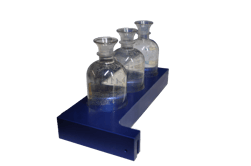
Available as an optional add-on, MANTECH offers a separate fixed rack located in front of the rinse station for placing calibration solution, storage solution(s), and QC checks instead of limiting the sample rack capacity. Capacities range based on autosampler and tube/cup size.
BOD QC Rack Options
| Part Number | # of Positions | Bottle Size | Autosampler Model |
| PB-10265 | 3 | 300mL | All AM400 Models |
What is the difference between membrane and optical DO probes?
BOD Pro Software™ detects the optimal time to automatically turn on the stirrer while taking DO readings. This feature improves operational efforts for analysts and streamlining your runs.
MANTECH’s BOD Pro analyzers utilize one of two dissolved oxygen probes from YSI for automated dissolved oxygen determination. View the measuring ranges of both probes, along with links to their complete specification sheets here.
Is the stirrer turned on manually or automatically?
BOD Pro Software™ detects the optimal time to automatically turn on the stirrer while taking DO readings. This feature improves operational efforts for analysts and streamlining your runs.
What is the maximum batch size of BOD Pro analyzers?
Although the number of racks is limited by the capacity of the autosampler performing BOD, there is no batch size limit. For example, an AM403 BOD Pro system using 18-place racks has a 54-position capacity but a batch of more than 54 can be set up in the software. Users would simply need to switch out the racks once the position capacity is reached. The BOD system would stop, and the software would prompt the user to add the next rack(s) in the batch.
How long does it take to measure initials and finals on a MANTECH AM400 series multi-rack system?
The length of time to measure initials and finals on a MANTECH AM400 series multi-rack system takes about 90 seconds but may vary depending on the method of sample preparation, sampler size, and probe style. For an individualized estimate contact us at [email protected].
Which regulatory standards do MANTECH’s BOD Pro systems conform to?
BOD Pro systems conform to: ASTM Standard Methods 5210B, 23rd and 24th editions, EPA 405.1, ISO EN 5815-1, ISO EN 1899-1, -2.
BOD Application
Are BOD results affected by atmospheric pressure changes?
Generally speaking, dissolved oxygen readings are dependent on atmospheric pressure. This is because the density of water changes with pressure, and this in turn affects the mg/L of dissolved oxygen. Here is a resource describing the “why” behind this. It is also dependent on temperature for similar reasons.The YSI meter does compensate for changes in atmospheric pressure. Here is a document explaining this. The document also provides advice for troubleshooting when challenges are occurring in BOD testing. One important aspect is to make sure you are calibrating the probe before each day of testing.
What is the BOD of raw sewage?
BOD can also be defined as the amount of oxygen required by the micro-organisms in the stabilization of organic matter. The results are generally expressed as the amount of oxygen taken by 1L sample (diluted with aerated water) when incubated at 20 degree for five days. BOD of raw sewage is 300-600 mg/L.
What does high BOD indicate?
BOD indicates the amount of putrescible organic matter present in water. Therefore, a low BOD is an indicator of good quality water, while a high BOD indicates polluted water. Dissolved oxygen (DO) is consumed by bacteria when large amounts of organic matter from sewage or other discharges are present in the water.
What is the difference between BOD and CBOD?
Biochemical oxygen demand (BOD) is a way to assess the amount of oxygen required for aerobic microorganisms to decompose the organic material in a sample of water over a specific time frame. It is the oxygen uptake demand of a source of water. Carbonaceous biochemical oxygen demand (CBOD) is the same method as BOD, but the nitrifying bacteria in the sample are inhibited. Nitrifying bacteria consume nitrogenous materials (compounds with reduced forms of nitrogen) and add to the oxygen demand of the wastewater. Nitrogenous materials are often seen as interference because the purpose of the BOD test is to measure carbonaceous material.
What is biochemical oxygen demand (BOD)?
Biochemical Oxygen Demand (BOD), also often referred to as biological oxygen demand, is a test performed to measure the potential of wastewater and other waters to deplete the oxygen level of receiving waters. In other words, the BOD test is performed to determine what effect dirty water, containing bacteria and organic materials, will have on animal and plant life when released into a stream or lake.
Get Smarter Solutions, Today.
Our innovative water and wastewater analyzers have faster, safer processes, with fewer hazardous reagents. Start using MANTECH solutions for more accurate data that drives responsible outcomes.