What is Coagulation-Flocculation?
Coagulation-flocculation are techniques used in drinking water and wastewater treatment to remove suspended solids, dissolved substances, and organic pollutants from water. Coagulation works by neutralizing charges on suspended particles. Flocculation binds the suspended solids together, preparing the source water for further treatment.
The challenge of this process arises from increasing natural organic matter concentration and variable source water quality. Factors including natural seasonal shifts such as snow and rain, climate change, and storm water intensification can contribute to variable source water quality, which complicates the treatment process.
On top of that, if a plant does not know the correct treatment doses, they risk overdosing or underdosing. Applying too little of coagulant does not clear the water of contaminants while overapplying is chemically unsafe for public health.
How does Jar Testing Optimize Coagulation-Flocculation?
Jar testing is a critical procedure used by many water treatment utilities to optimize coagulation-flocculation treatment in terms of coagulant dosing, cost and performance. It simulates the process with variable doses to determine the optimal treatment for different conditions.
Though, it has seen little change since its early development and remains time consuming and material intensive. Untreated water is stored in storage vats and must wait for jar testing results; it cannot be used by consumers and takes up a lot of space until it is treated. Currently, jar testing has low data throughput, relies on end-point sampling, requires manual handling and can be prone to error.

Optimizing Jar Testing with MANTECH
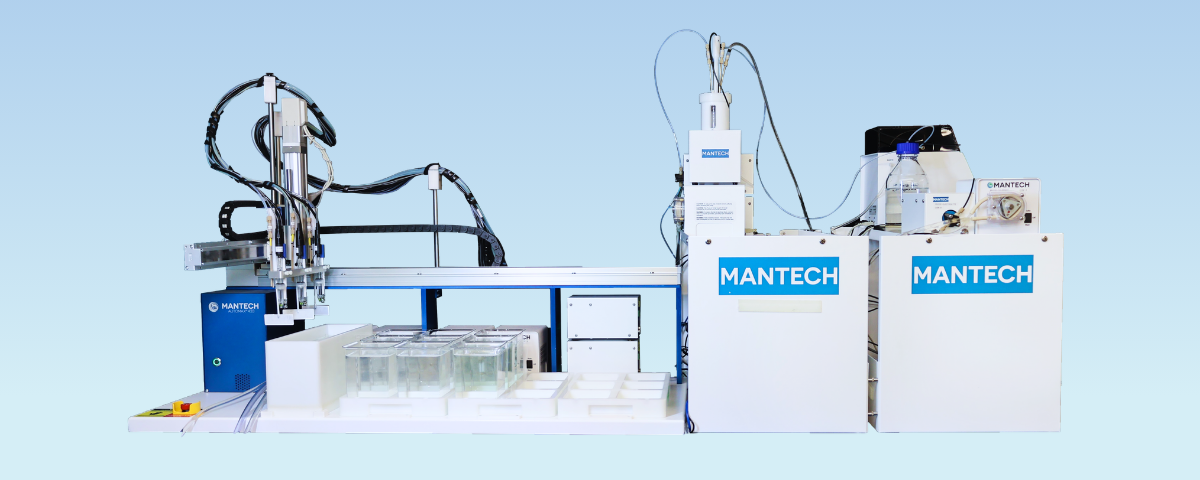
In collaboration with Dalhousie University, MANTECH has made an advancement in developing the first automated, high-throughput jar testing system with additional capabilities to address these challenges. While this system is mainly applicable to drinking water, it is also applicable to wastewater treatment.

MANTECH’s jar testing system is capable of:
- Performing user-defined jar testing procedures
- Multi-channel analysis, up to 6 jars at once, with 6-40 jars of capacity
- Customizable coagulant dosing volumes
- Automatic pH adjustment
- Multiple flocculant cycles
- Continuous measurement of pH and conductivity
- Multiparameter analysis such as turbidity, COD and more for initial, post-coagulant addition, final and settled jar testing results.
- Reporting of pre-treatment, post-coagulant addition & pH adjustment, continuous post-treatment and settled parameters

The system enhances a plant’s adaptability and resilience to challenges of increasing natural organic matter concentration and water quality variability stemming from seasonal shifts and climate change.
With automated features such as customizable dosing and multiple flocculant cycles, operators can save time with less manual handling and human error.